
Engineering Quiet Data Centers: Practical Acoustic Design, Testing, and Modeling for New Builds
Designing a data center that meets acoustic requirements is not a retrofit exercise. It is a design discipline that belongs alongside civil layout, MEP coordination, structural design, and equipment procurement from the very beginning. When acoustic performance is addressed early, teams avoid costly late-stage mitigation, permitting friction, and redesign of rooftop and yard layouts.
This guide walks through what to consider & how VEC can help with proper acoustic testing & modeling to help you have a successful build.
Identify All Noise Sources During Design
The first step is not mitigation. It is complete source identification while the design is still fluid.
Mechanical Cooling Equipment (Primary Drivers)
Key sources include:
- Air-cooled chillers
- Cooling towers / fluid coolers / dry coolers
- CRAH / CRAC fan arrays
- Large axial and centrifugal fans operating continuously
These sources produce a mix of broadband airflow noise and tonal fan noise. Tonal components travel farther, are more noticeable at property lines, and must be accounted for explicitly in modeling.
Action during design: Require manufacturer sound power data for every major mechanical unit before equipment selection is finalized.
How VEC Helps: We review all manufacturer sound power data for every major mechanical unit.
Electrical and Backup Power Systems
- Diesel generators (steady operation and test cycles)
- Transformers with persistent low-frequency hum
- Exhaust discharge and intake louvers
- Switchgear rooms tied to exterior louver paths
Action during design: Include generator operating scenarios and transformer hum in the acoustic model, not just cooling equipment.
How VEC Helps: We include generator operating scenarios and transformer hum in our acoustic modeling.
Structure-Borne Vibration That Becomes Audible Noise
Rooftop and slab-mounted equipment transmits vibration into the structure. That vibration re-radiates as audible sound through walls and roofs.
Action during design: Specify vibration isolation as part of the acoustic strategy, not just for equipment protection.
How VEC Helps: We specify vibration isolation as part of the acoustic strategy, not just for equipment protection.
Account for Noise During Site Planning and Layout
Design considerations:
- Distance from equipment to property lines
- Using the building mass as a sound shield
- Leveraging parapets and elevation changes
- Clustering vs distributing equipment across the roof or yard
- Orienting discharge away from sensitive directions
A small layout adjustment early can eliminate the need for large mitigation structures later.
Perform Pre-Construction Acoustic Modeling (Critical Step)
Acoustic modeling must occur before equipment procurement and final layout. This is where design teams make the highest-impact decisions at the lowest cost.
Required Inputs
- Manufacturer sound power data for all major equipment
- Site topography and grade changes
- Building geometry and height
- Equipment elevations, orientations, and discharge paths
- Surrounding buildings and reflective surfaces
- Daytime and nighttime ambient conditions
- Full cooling load operation
- Generator test scenarios
- Sound levels at property lines and known receptors
The VEC Acoustic Modeling Process for Data Centers
Leveraging deep experience with high-tech facilities, VEC applies a structured, data-driven process specifically tailored to data center design, permitting, and compliance.
1) Ambient Noise Measurements
This accounts for:
- Nearby roads and highways
- Airports and flight paths
- Rail lines
- Adjacent industrial activity
These measurements establish a defensible acoustic baseline that ensures predictions are grounded in real site conditions, not assumptions.
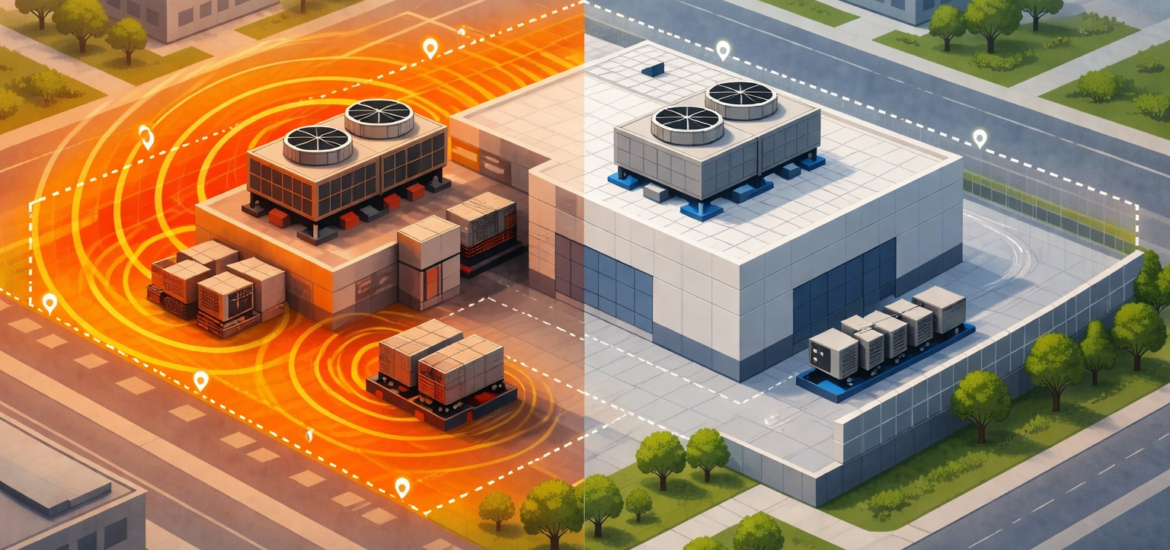
2) Equipment Noise Modeling
For every chiller, cooler, generator, transformer, and major fan array, VEC predicts:
- Sound levels at the property line
- The effect of distance, elevation, and orientation
- Shielding from the building and parapets
- Line-of-sight discharge paths
This step reveals which specific pieces of equipment are the dominant contributors and where layout changes will have the most impact.
3) Cumulative Noise Analysis
Predicted levels are compared directly against:
- Local noise ordinance limits
- Nighttime vs daytime thresholds
- Sensitive receptor locations
This identifies whether the overall design will comply before construction begins.
4) Noise Mitigation Design
Typical solutions include:
- Acoustic barriers and screen walls integrated into civil plans
- Equipment enclosures and louver silencers
- Layout and orientation adjustments
- Selection of lower-noise fan options during procurement
Because this occurs during design, mitigation becomes part of the drawings — not an afterthought.
5) Permitting-Ready Documentation
VEC delivers a formal Data Center Noise Report suitable for submission to local authorities.
This report provides:
- Baseline ambient measurements
- Predictive modeling results
- Mitigation design details
- Clear evidence of compliance with local ordinances
For developers and builders, this documentation significantly reduces permitting friction and demonstrates due diligence to municipalities and stakeholders.
Result: Acoustic performance is engineered into the data center from the beginning, with clear proof that the facility will meet requirements before it is ever built.
Provide Documentation for Permitting and Compliance
- Predictive modeling report
- Equipment sound data documentation
- Mitigation design details
- Field test results and validation
Providing this package to municipalities and stakeholders demonstrates compliance before issues arise.
Optimize for Long-Term Acoustic Performance
Consider:
- Future equipment additions
- Increased fan speeds at higher loads
- Seasonal operating differences
- Maintenance of screens, isolators, and louvers
Acoustic performance should remain stable as the facility evolves. Work with VEC to ensure your data center meets acoustic requirements from day one through precise modeling, smart design guidance, and permitting-ready documentation.