
Magnetic fields are among the most common and disruptive sources of interference in electron microscopy laboratories. Both alternating current (AC) and direct current (DC) magnetic fields can cause image degradation, instrument instability, and data inconsistency.
Understanding how these fields behave, where they originate, and how to control them is essential for achieving stable, high-resolution performance from transmission and scanning electron microscopes (TEMs and SEMs), dual-beam FIBs, and similar tools.
This article outlines the strategies for magnetic field mitigation for TEMs, and it describes why a dual cancellation system is the most appropriate active magnetic field cancellation strategy for very high-resolution TEMs with extremely tight specifications.
How Magnetic Fields Affect Electron Microscopes
Electron microscopes rely on a precisely aligned electron beam to create images at nanometer or atomic scales. When external magnetic fields are present, they interact with this beam bending or deflecting it slightly and produce visible artifacts on the image.
- AC magnetic fields (typically 60 Hz and harmonics) cause “flagging” or moving bands across the image. These oscillations create a constant beam wobble synchronized with the power frequency, degrading image clarity and usability.
- DC magnetic fields, which are static or slowly changing, lead to beam drift or misalignment. This can make focusing difficult and cause positional errors during imaging or patterning.
Both forms of interference can render otherwise well-designed facilities unsuitable for precision microscopy unless properly addressed.
The Challenge of High-Resolution TEMs
However, TEMs with long columns present challenges. A single-cancellation system setup strategy involves arranging the cable layout to achieve uniform cancellation along the electron beam column, often using a dual-loop configuration. VEC then places the sensors at the center of the column for optimized cancellation.
This strategy has shortcomings in two scenarios:
- High Field Gradient: When there is a significant gradient in magnetic fields between the top and bottom of the microscope, optimizing cancellation at the center results in over-canceling at one end and under-canceling at the other.
- Tight Specifications: When specifications are very tight, any variation or gradient in the field becomes challenging to manage, especially in the 20-10 nanoTesla peak-to-peak range.
How Magnetic Fields Behave (AC vs. DC)
When analyzing laboratory environments, it helps to understand how different field types behave spatially and with distance:
AC Magnetic Fields
AC fields are time-varying and alternate direction 60 times per second (in North America). These are directly tied to building electrical systems. Their amplitude depends on the current load as electrical demand increases; field strength increases proportionally.
With the tight specifications, instrument costs, and operational importance of high-resolution TEMs, customers often go to great lengths to protect their TEMs from electromagnetic interference. One way to do this is through room shielding. Below, we will describe different shielding techniques, their physical principles, and considerations for their application.
DC Magnetic Fields
DC fields are static or slowly changing. They are created by ferromagnetic materials (like steel structures or moving metal doors) or by large, slow changes in DC current (e.g. capacitor discharge equipment, rail power lines, or electric vehicles). While weaker overall, they can be highly disruptive due to their persistence and inability to be time-averaged out by the microscope.
Field Decay & Spatial Behavior
Magnetic fields weaken with distance but not linearly. Three general categories of decay behavior describe how different source types behave:
Net Current Fields – Caused by unbalanced current flow (e.g. 2 A out, 1 A return), these fields decay roughly as 1/r and are common in wiring errors or shared neutrals.
Here is an example where a single wire goes to a power source, sometimes seen when lights are improperly wired in series.
Here is an example where there are two unbalanced wires. There is still a net current because the return current does not cancel out the magnetic fields.
Dipole Fields– Produced by distribution equipment, branch panels, or split-phase circuits. These typically decay as 1/r².
Transformer or Coil Fields – Associated with inductors or transformers and decay faster, about 1/r³, but are intense near the source.
VEC uses proprietary modeling software that incorporates measured exponents and coupling coefficients to predict field behavior precisely in 3D space.
Sources of Magnetic Fields
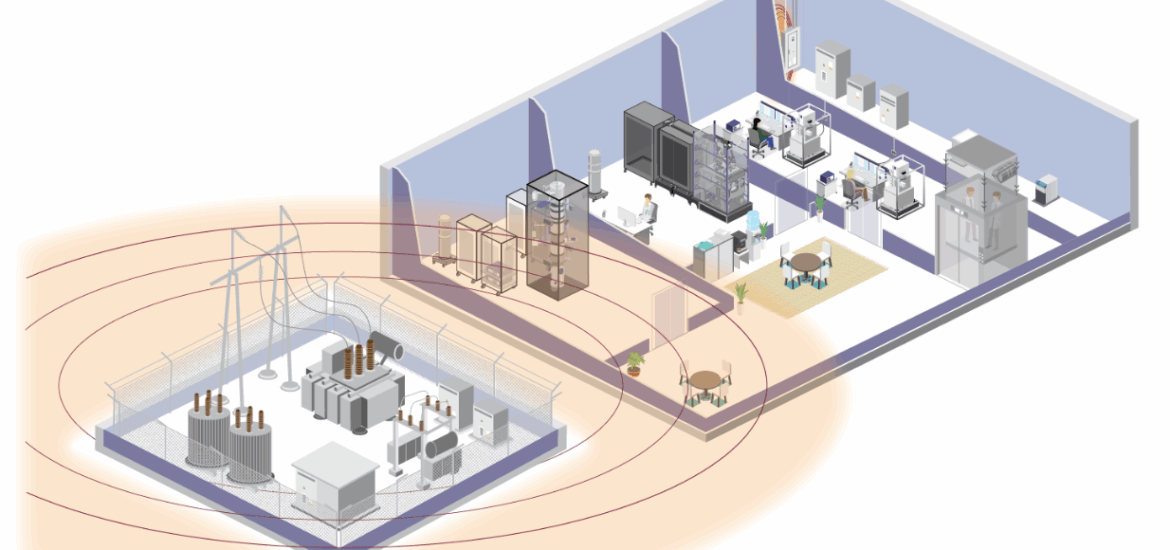
Magnetic field sources can be grouped into two categories: inside the microscopy lab and outside or external to it.
AC Magnetic Field Sources
Inside the Lab
- Wiring & Outlets
Poorly balanced electrical circuits, shared neutrals, or misrouted return paths create net current imbalances. These are common in renovated buildings or tenant-improved spaces. - Lighting Systems
Historically, fluorescent fixtures with magnetic ballasts (common through the 1980s) were notorious for generating 60 Hz magnetic interference. Today’s LED systems use electronic drivers that operate at much higher frequencies and do not produce low-frequency magnetic fields though misconceptions about LED “magnetic noise” persist. - Raceways & Power Tracks
Bench-mounted or wall-mounted power tracks are convenient but often electromagnetically unbalanced. Cheap or poorly designed raceways separate conductors widely, increasing net fields. High-quality, balanced systems or shielded conduits are recommended near microscopes.
Outside the Lab
- Building Busways & Feeders
The most significant AC magnetic fields come from main electrical busways, switchgear, and feeder conduits that distribute power across the building. When phase conductors are not properly grouped, they create large, slowly decaying magnetic fields that can extend through floors and walls. - Mechanical & Utility Rooms
Spaces housing chillers, pumps, or variable-frequency drives (VFDs) often contain high currents and harmonic loads that radiate into nearby laboratory zones.
DC Magnetic Field Sources
Inside the Lab
- Ferromagnetic Objects
Metal doors, stainless-steel kick plates, or nearby lab furniture can distort the static magnetic field around the microscope. When these objects move, even slightly, the resulting field shift causes the beam to jump. - Temporary or Mobile Equipment
Forklifts, carts, or metal tools brought near the microscope can introduce temporary field variations, producing image instability.
Outside the Lab
- Large Magnetic Structures
Steel building columns or rebar mats near or under the lab can distort the local field, particularly if magnetized during construction. - Changing DC Currents
Facilities adjacent to light rail systems, electric vehicle chargers, or capacitor discharge equipment experience fluctuating DC fields as currents switch or pulse. These appear as gradual drifts or sudden beam shifts on the microscope display.
Mitigation Strategies
Designing a magnetically quiet lab requires a mix of good electrical practice, baseline measurement, and active compensation.
Passive & Design-Based Mitigation
- Balanced Wiring
Always route supply and return conductors together, either twisted or in metallic conduit, to minimize loop area and cancel fields. - Conduit & Raceway Selection
Use shielded raceways and ensure conductors are closely coupled. Avoid long single-conductor runs and unpaired feeders. - Room Layout & Equipment Placement
Position sensitive instruments away from major electrical risers, switchgear rooms, and high-current utilities. Maintain several meters of separation wherever possible. - Material Selection
Use non-magnetic materials (e.g. aluminum or stainless steel grades 304/316) for doors, casework, and structures near the microscope.
Measurement & Verification
Baseline site testing is critical during site selection and commissioning.
- Measure both AC and DC magnetic fields under realistic loading conditions.
- Re-test once the building is fully occupied because total field strength often increases as equipment is added and current loads rise.
At VEC, our site surveys use fluxgate and search-coil magnetometers to map fields at multiple frequencies, allowing us to correlate sources with building infrastructure.
Active Magnetic Field Cancellation
When external sources cannot be eliminated, for instance, from shared building utilities, nearby light rail systems, or adjacent labs, active magnetic field cancellation systems provide a proven solution.
Systems like the Spicer SC-24, installed by VEC, use sensor arrays to detect ambient magnetic fluctuations and create counteracting fields in real time. Properly configured, these systems can reduce AC and DC field levels by more than 90%, restoring imaging stability without structural modifications.
Summary
Both AC & DC Magnetic fields are invisible but powerful disruptors of precision microscopy.
- AC fields from building wiring, feeders, and equipment generate 60 Hz flagging and image jitter.
- DC fields from moving ferromagnetic objects or variable DC currents cause slow beam drift and misalignment.
Mitigating both requires a combination of balanced electrical design, field testing, and active control.
With careful planning and expert analysis, laboratories can achieve the stable, low-noise magnetic environments required for high-performance imaging and microfabrication.
At VEC we specialize in magnetic field modeling, AC/DC site testing, and cancellation system design to ensure that advanced instruments perform exactly as specified even in complex, multi-tenant research facilities.